Barcelona city was home for many years, so I’ve put together this guide to explore its different neighbourhoods and share accommodation options I personally recommend.
Districts
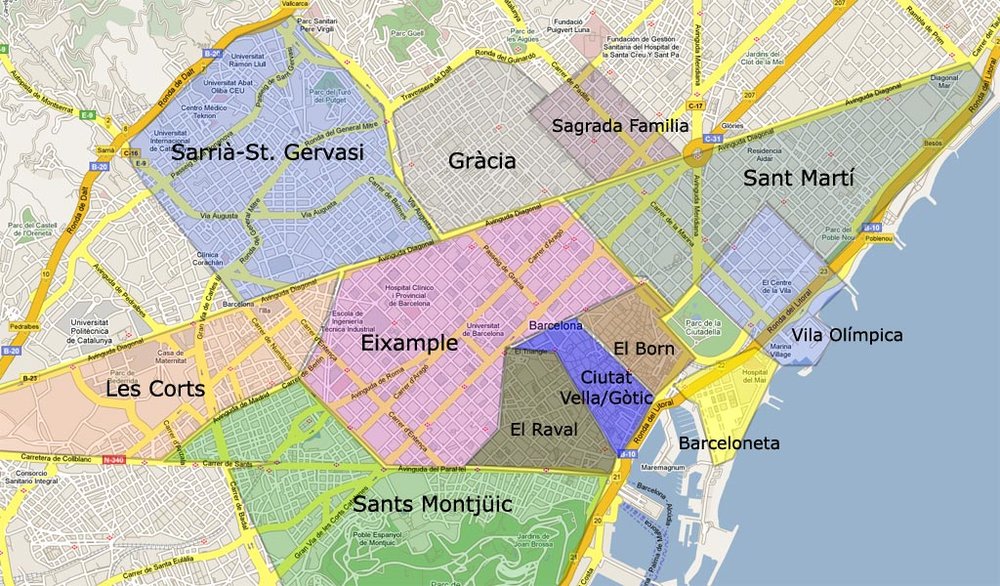
Barcelona is Spain’s second-largest city and the capital of Catalonia, with a population of around 1.7 million. It is divided into 10 districts, each with its own distinct atmosphere, rhythm, and character. While all offer something unique, some are particularly well suited to first-time visitors.
In this guide, I will focus on the districts I consider most appropriate for a first stay in Barcelona—and therefore the areas I recommend for hosting your guests — places that combine ease, charm, and a strong sense of place.
Eixample
Eixample is the city’s most populated district, divided into two main parts: Eixample Esquerra (Left) and Eixample Dreta (Right). The central area is often referred to as Antiga Esquerra de l’Eixample (Old Left Eixample).
Given its scale, I generally recommend staying in or around the central stretches of the district, as the outer edges tend to feel more residential and less immediately connected to the city’s main points of interest.
At its heart, Eixample is defined by its wide avenues and elegant shopping streets, most notably Passeig de Gràcia and Rambla de Catalunya. It is also the district most closely associated with Barcelona’s Modernist heritage, home to some of Antoni Gaudí’s most iconic works, including Sagrada Família, Casa Batlló, and La Pedrera. The atmosphere here is refined yet lively, with broad streets, considered architecture, and an excellent selection of shops and restaurants.
In this area, I suggest the following hotels:
Hotel Catalonia Ramblas, Hotel Catalonia Plaça Catalunya, Pulitzer Hotel. Hotel Mandarin Oriental, Cotton House Hotel and Sir Victor Hotel.
Barceloneta / Vila Olimpica
Barceloneta is the city’s closest district to the sea, with a distinct village-like atmosphere that sets it apart from the rest of Barcelona. Originally a former fishing quarter, its narrow streets almost always lead toward the beach. The area is unpolished in the most authentic sense—less refined, but full of character, shaped by its working-class roots and a constant mix of locals and visitors.
Accommodation options here are relatively limited, with the notable exception of the W Barcelona, which has become something of a modern landmark. It is also important to keep in mind the distance to the historic centre; reaching areas such as El Born takes around 15–20 minutes on foot.
Vila Olímpica del Poblenou lies just along the coast, slightly closer to the Port Olímpic area. This part of the city is more contemporary in feel and is known for its nightlife, with venues such as Shôko, Carpe Diem, Opium Mar, and Pacha located nearby. It offers a more energetic, late-night atmosphere compared to Barceloneta.
Recommended hotels in this area include:
- Hotel Arts Barcelona
- Pullman Barcelona Skipper
Barcelona is a city where one needs to choose between the beach or the city centre—being super close to both isn’t possible.
El Born
El Born is a characterful and bohemian district within the historic heart of Ciutat Vella. It is an area defined by atmosphere and history in equal measure—narrow medieval streets, centuries-old buildings, and a sense of scale that feels unchanged in many parts.
I rented my first room here when I moved to Barcelona in 2009, in a 13th-century building. I still remember waking up on Sundays to the church bells of Santa Maria del Mar—a sound that, for me, has always defined the neighbourhood. It remains a place I hold in very high regard.
Today, El Born is known for its intimate streets, independent boutiques, and cozy atmosphere. Passeig del Born serves as its main axis and is particularly lively in the evenings, with a refined but relaxed selection of bars and restaurants.
Just next door lies Parc de la Ciutadella, one of the city’s most beautiful green spaces—ideal for slow walks, picnics, or people watching. For coffee, my husband says Café El Magnífico is among the best in the city, though it is very much a place to take away and enjoy as you wander.
In this area, I recommend this hotel: Hotel Borneta.
El Gótico
Barri Gòtic is the Gothic Quarter of Barcelona and, by far, the most visited part of the city’s old town. Also within Ciutat Vella, it is separated from El Born by Via Laietana. While both neighbourhoods share medieval origins and centuries-old architecture, El Gòtic feels denser, more layered, and more frequented by visitors.
The district is defined by its labyrinth of narrow streets, small squares, and historic buildings. Around every corner you will find a mix of boutiques, cafés, restaurants, and everyday services, all set within structures that have evolved over centuries. It is a place designed for wandering, where getting slightly lost is part of the experience.
In this area, I recommend the hotel: La Duquesa de Cardona, Serras, Wittmore Hotel, Kimpton Vividora, Grand Hotel Central, H10 Cubik and The Barcelona Edition.
Montjuïc
Montjuïc is a landscaped hill overlooking the city, offering some of the most striking views over Barcelona and the coastline. It feels slightly set apart from the urban rhythm below, while still remaining very close to the centre.
There is only one hotel located here, which makes it a very particular choice—but an appealing one if you are looking for a quieter setting without sacrificing proximity to the city. A taxi to the centre takes under 10 minutes, and there is a designated taxi area directly by the hotel, which makes access straightforward and reliable.
The Hotel in this area is Hotel Miramar.
So there you have it! I hope you found this useful!
Leave a Reply